
We’ve discussed plenty of times on this blog the many decisions, considerations, positives and negatives one must tackle when picking a new fireplace for their home. Traditional vs. contemporary, gas vs. electric, wall mounted vs. floor standing, and so on. But we’ve yet to discuss these decisions as they relate to motorhomes.
 Caravaning is still a huge business in the UK. While most are satisfied with going to a caravan site and renting one out for a week, many others prefer to own their own, either static or mobile. Motorhomes are an even bigger pastime in other countries, such as the US, where motorhomes are a way of life.
So lets say you are the proud new owner of a caravan, and want to fit it with the creature comforts of your living room. You don’t want the traditional, central heating-like system the vehicle comes fitted with, so which fireplace is right for you? Let’s examine the three options.
Wood Burning Stoves
Right away, a wood burning stove is less than ideal for the vast majority of caravans. Concerns over space come first and foremost. Not only do stoves require a flue, meaning extra work on the outside of your caravan or motorhome, but they also require you to carry around their fuel, too. Plus in these confined spaces, fires are easier to ignite and can get out of control quickly, especially worrisome with the gas stored relatively nearby.
But this isn’t to say that a wood burning stove is completely out of the question. For one, huge luxury motorhomes will easily have the room to spare, and the modern stoves York Fireplaces have in stock will look great in these 21st century marvels. You could also choose to get a portable one, which you can use outside your caravan when you want to sit outside all night.
Gas Fireplaces
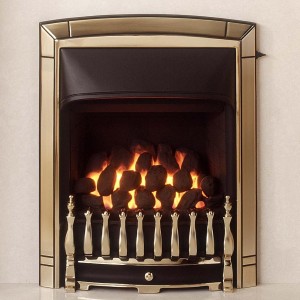 Gas fireplaces are a good choice for caravans and motorhomes. Of course, they will require a flue to be fitted, but they don’t come with the other drawbacks that come with stoves. For one, the chances of the fire getting out of control are slim to none. Plus, with gas on board as standard, there is no need to haul around extra fuel. Their small size means they are also easier to accommodate into the existing layout.
One concern you may want to keep in mind though. As gas fireplace are connected to the main gas line in homes, there is no worry about running out of fuel. You may therefore leave gas fireplaces roaring all day. But with caravans, there is a finite amount of fuel they can carry, and it is used for such things as cooking and heating water, on top of the fireplace. If home habits creep in, you could find you are replacing the gas tanks frequently.
Electric Fireplaces
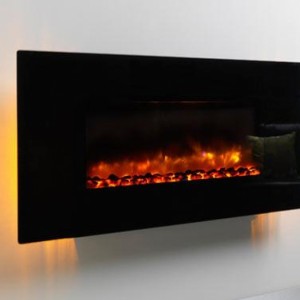 For us, electric fireplaces are the ideal choice. No internal flames means the chances of fire are even less likely than they are with a gas fire. Plus, electric fires open up the possibility of getting a wall hung unit, saving cupboard space and allowing more variety over its positioning. As it only needs to be near a plug, there is also no need to route a gas line to it.
The only downside is that it too runs on a finite amount of fuel. Caravans can only carry a certain amount of electricity without an electrical hook-up point, whereas gas fireplaces can be used on-the-go as long as there is gas onboard. But should there be an electrical hook up point, you gain access to infinite amounts of power, so you can run your fireplace for as long as you want!